Volvo Group • INDUSTRY CAPSTONE • 2025
Volvo Group’s fleet management platform
Timeline
3 months
Role
Product Designer (Me!)
Team
Business Development
Product Manager
UX Research
Engineering
TL;DR
As part of the MS-HCI program’s industry capstone at UC Santa Cruz, I shaped the vision for integrating Generative AI into Volvo Connect, Volvo Group’s fleet management solution.
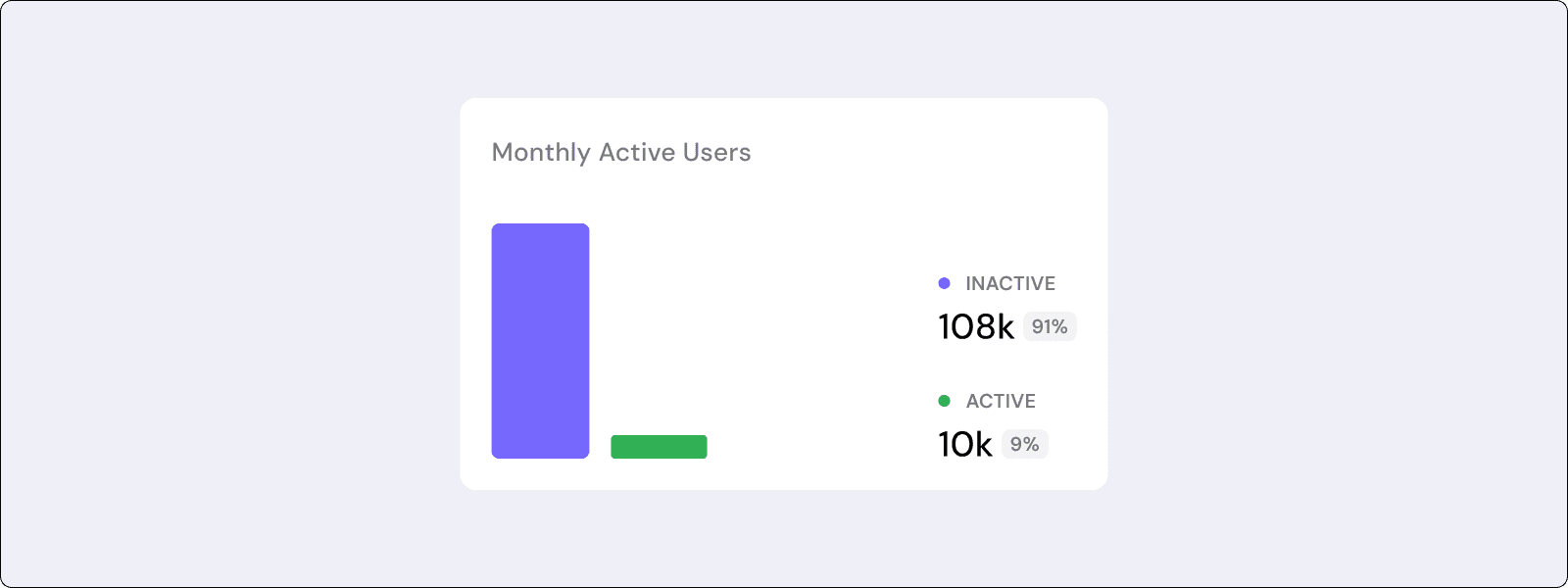
Volvo Connect has about 118k onboarded users, of which only about 9% regularly return to the platform. Through discovery research, we learnt this was primarily due to difficulty deriving actionable operational insights from available telematics data.
As the sole product designer, I designed an AI-powered analytics agent that answers fleet questions directly from telematics data, improving discoverability of actionable operational insights while reducing time and effort required for fleet managers.
↓ 90%
Time on task
MEASURED
↓ 35%
Support calls
Projected
↑ ~7500
Active Users
Projected
Solution
Here are some of the key features
Intelligent Alerts
Reduces user alert fatigue by only highlighting critical fault codes (which require immediate attention) while supporting subsequent triage.
On-Demand Analysis
Answers fleet questions using telematics data, providing actionable operational insights w/o analytical expertise or dedicated personnel.
Asset Data Selection
Binds your question to a specific asset and pulls from that record exclusively, rather than inferring which asset the user meant.
Overview
Volvo Group is a global manufacturer of trucks, buses, construction equipment, and marine and industrial engines.
Founded in 1927 and headquartered in Gothenburg, Sweden, the company employs over 100,000 people and is among the world's largest manufacturers of heavy commercial vehicles.

NASDAQ:VOLV B
Problem
Most onboarded fleet managers never return to Volvo Connect.
Along with the purchase of a Volvo Truck, customers are offered two years of complimentary access to Volvo Connect, Volvo Group’s fleet management solution. They’re onboarded at the point of sale, but of the 118k fleet managers onboarded, only about 9% return to the platform regularly.
User Research
User interviews uncovered that fleet managers found Volvo Connect too effortful to use, including the telematics data that sets it apart.
Secondary research had shown Volvo's proprietary telematics to be a significant competitive advantage, so I wanted to understand why fleet managers weren't taking advantage of it. To learn more, we recruited and interviewed 15 fleet managers with the help of partner dealerships.
It's not that we don't want to use Volvo Connect, we just can't dedicate the time or personnel required to get value out of it. It's just easier to use Geotab or Motive.
We learnt that fleet managers recognize the value of Volvo Connect and its offerings, but felt that the time and effort required to derive actionable operational insights using the platform's current methods far outweigh the benefits it offers. The biggest contributing factors were as follows.
Data w/o Actionable Insight
Volvo Connect provides a wealth of telematics data but stops short of insight, leaving little of it readily actionable.
Alert Fatigue
Faults arrive by the hundreds with limited triage, making it challenging to distinguish critical faults from routine ones.
Fragmented Ecosystem
The trucking industry is historically siloed, forcing fleet managers to navigate multiple applications to complete routine tasks.
Partial Fleet Visibility
Volvo Connect is single-OEM, so users running mixed fleets turn to brand agnostic third-party tools for a full fleet view.
User workarounds driving engagement down and support costs up.
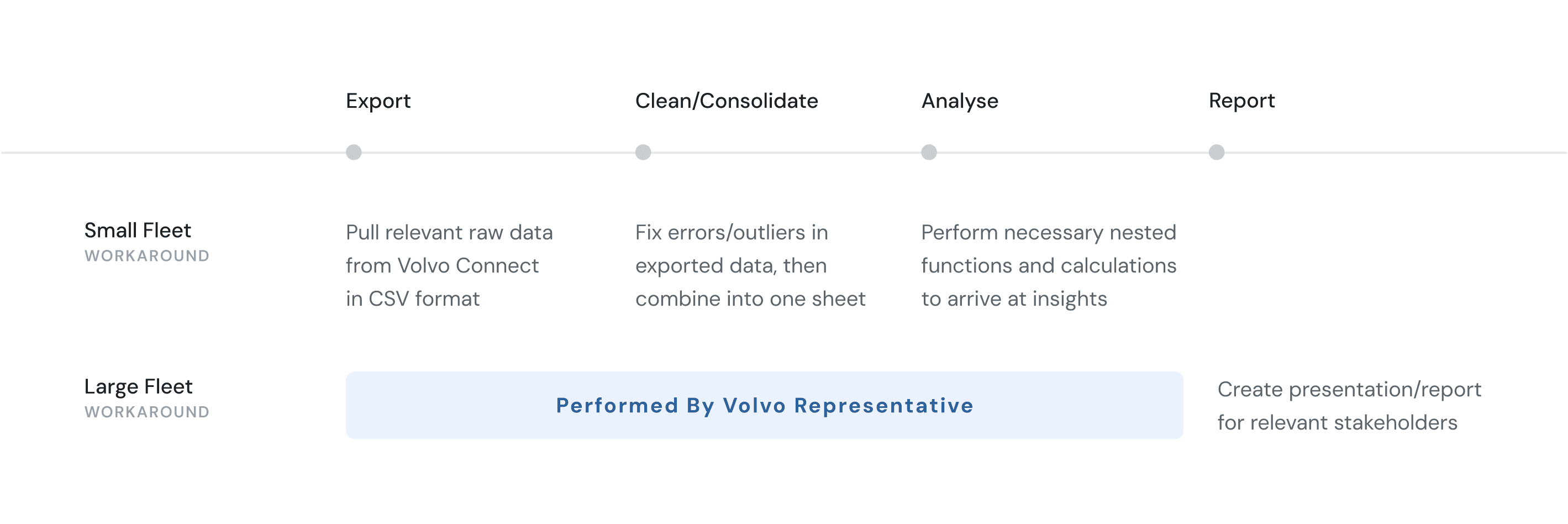
While most users disengage from the platform entirely in favor of third-party solutions, a small minority still prioritize Volvo's data — exporting it to work with elsewhere, taking their activity outside the product.
Larger fleets skip interfacing with the platform altogether, requesting dedicated Volvo representatives to support their telematics analysis directly. It's an expensive workaround that's challenging to scale.
Research debrief with the business and engineering made clear which problems were ours to solve.
Business development explained that the company's official position is that it doesn't share proprietary OEM data with competitors or third-party platforms. As a result, partial fleet visibility wasn't a problem we could fix.
On fragmentation, engineering explained that the problem runs deeper than the interface. Volvo's logistics operation is large and heavily siloed, and unifying the ecosystem would mean aligning departments that don't currently share systems. That left the two we could address: data without actionable insight, and alert fatigue.
How Might We

Help users arrive at actionable operational insights with minimal effort?
User goal
Drive platform adoption?
Business goal
Ideation
Two ideas satisfied the brief. Business strategy was the tie breaker.
I facilitated a workshop with business development, product management, and engineering, sketching against our HMWs and research findings. Using crazy 8s, we generated a wide set of ideas and discussed each against user value, business value, and feasibility.
We narrowed it to two: a dashboard redesign and a conversational assistant. The dashboard was the safer build; it worked with data the platform already surfaced and asked less of engineering. However, the assistant provides more user value by removing the need for manual analysis.
Both were defensible. But it was 2025, and Volvo Group had a vested interest in showcasing their digital innovation. Generative AI was the obvious vehicle, and the conversational assistant won out.
A capability inventory defined what the agent can/can't achieve.
Before designing anything, I sat down with engineering to understand what the product could reach — what data it could access, what APIs it could call, and what actions it was permitted to take.

Since ASIST and Parts ASIST were inaccessible, service management was out of scope. The agent's capabilities were to analyze data, generate insight, and recommend action. Additionally, building atop Amazon Quick's existing data and agent infrastructure reduced the engineering effort.

AI-Powered Business Intelligence
Confirming the idea was worth building.
With the scope established, we tested the concept with five representative users using a low-fidelity prototype. The response was unanimously positive. Participants noted that small and mid-size fleets have no dedicated analytical support or means of performing this analysis within the constraints of their current workflow.
Against that baseline, an assistant was a definite improvement, and occasional inaccuracy was an acceptable trade-off for making telematics data more accessible.
Design Process
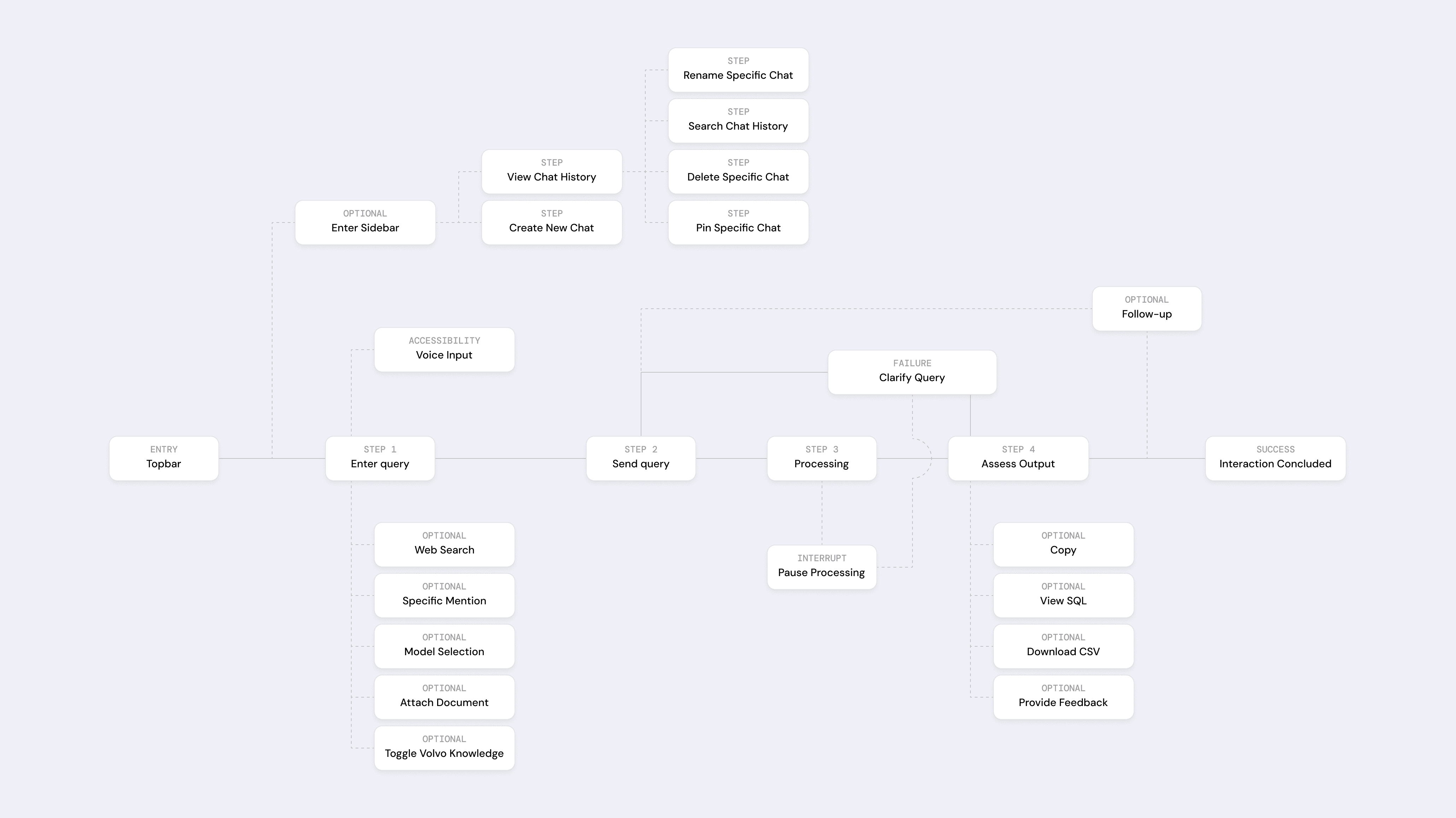
Mapping every action the agent interface needed to support.
Before building anything, I mapped the full interaction surface: where users enter, every optional action available at each step, and what happens when the agent can't proceed. Failure paths were mapped alongside successful ones rather than added afterward.
Leveraging Volvo's experience system meant I could skip low fidelity, so every iteration was a version of the final product.
Volvo's design system covered most of what the interface needed, so I built with real components from the first iteration. Three rounds followed, each a working prototype rather than static mocks.

Building reusable components of the patterns that weren't available within Volvo Group's existing experience system.
Given that this was early in the development of AI solutions, Volvo Group didn't have reusable components to use within their experience system. To support this, I built reusable components based on my designs and Volvo Group's AI Chat guidelines and principles for key elements.


Finding areas of improvement in the current experience through iteration and usability testing.
We ran about 15 usability tests to find areas of improvement, we walked users through the current experience while keeping in mind all the insights we learnt during user research. When a need felt unmet, we wrote it down and this became the focus of future iterations.

BEFORE
No way to export data or verify logic.
AFTER
Export csv data for each query and review SQL code to verify logic.
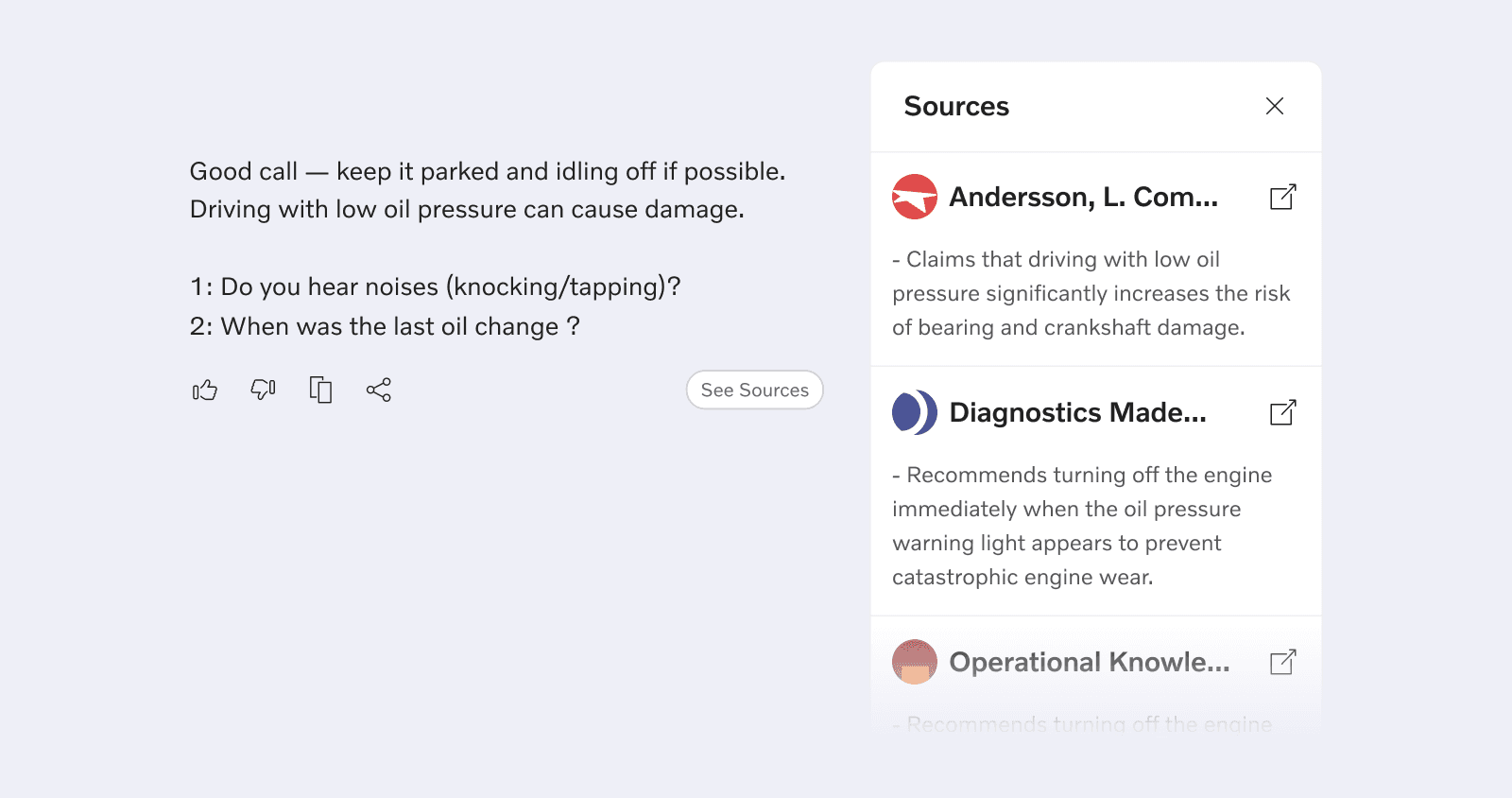
BEFORE
No way to verify information provided.
AFTER
See sources that Fleet Assist relied on to arrive at the answer provided.
Some mocks of the final solution


Outcome
We project that the number of fleet managers leveraging telematics data will go up in the months ahead — especially among small fleets.
↓ 90%
Time on task
↑ ~7,500
MAU (Projected)
↓ 35%
Support calls (Projected)
Reflection
My key takeaways and learnings!
Start recruiting participants early!
Especially in niche domain, recruiting representative users can be challenging so start early and reach out to company contacts.
Iteration! Iteration! Testing!
While data and research showed us exactly what to fix, we wouldn't have arrived at the right solutions without feedback from users.