GoodWorker • Hiring platform • 2023
Earning trust in a hiring market that runs on referrals
Timeline
5 months
Role
UX Research, UX Design
Tools
Figma, Google Suite
TL;DR
GoodWorker, a blue-collar hiring startup that has raised over $23M, wanted an employer portal that could match WorkIndia and Apna on day one and then pull ahead. The catch: in this market, hiring runs on referrals, WhatsApp groups and middlemen, because almost nobody trusts the platforms.
I interviewed job seekers, employers and recruiters across three cities, turned what they told me into jobs-to-be-done maps and personas, and audited GoodWorker against its competitors. Then I designed the portal employers and recruiters use to post jobs and move candidates through hiring: 30+ flows across web and mobile web, now live.
38
In-depth interviews across all three sides
14/20
Job-seeker needs met offline, not online
30+
Flows shipped across web and mobile web
Solution
A portal that builds trust into every job post and replaces the spreadsheet

A job post that nudges toward reach
Posting takes three short steps: job details, candidate requirements, review. “Maximum reach” tags mark the choices that widen the pool, like less than 10th pass or any gender, steering employers away from the certificate filters that lock most workers out.

The pipeline is the product
Recruiters were tracking candidates by hand in Google Sheets and losing them. Every applicant now sits in one list with a hiring stage, a last-contact status and a note: pending, shortlisted, selected or rejected.

Trust, designed into the form
Every post asks whether the candidate will be charged a fee and confirms the poster is authorised to hire for that company. Ads go live instantly only once a document is verified, so workers see a verified badge before they ever call.
Overview
GoodWorker matches India’s blue-collar workers (drivers, delivery staff, security guards, retail and sales staff) with the companies that hire them.
India has roughly 50 crore blue-collar workers, and most of them still find work the way their parents did: through people. The brief came in two parts. MVP0 was parity: match what WorkIndia, Apna and the Facebook and WhatsApp job groups already do, so nobody has a reason to leave. MVP1 was the harder half: improve how workers, recruiters and employers connect, give recruiters a dashboard worth opening, and build enough trust that people stop treating every listing as a possible scam.
Blue-collar hiring platform, India
Problem
A three-sided market where every side works around the platform.
Job seekers don’t trust online listings, so they lean on referrals. Employers expect instant results and fall back on their own network the moment a platform stalls. Recruiters sit in the middle, holding it together with phone calls, WhatsApp groups and spreadsheets. Each workaround makes sense on its own. Together, they route hiring around the product.


User Research
Before deciding what to build, I talked to all three sides.
38 in-depth interviews: 16 job seekers across Delhi NCR, Jaipur and Mumbai, 14 employers ranging from small shops to 500+ person enterprises, and 8 recruiters running agencies of 10 to 100+ people. Quick intercept interviews tested early hypotheses along the way. I reduced each conversation to quotes, mapped them onto empathy maps and one-page sketchnotes, and synthesised everything into jobs-to-be-done.
In parallel, I ran a heuristic evaluation of GoodWorker, WorkIndia, Apna and Vahan, and mapped which jobs each competitor actually served, so every recommendation could point at a screen rather than a principle.
“In the last 8 years I haven’t looked for jobs, because everyone asked for proof.”
Job seeker
“The first thing candidates ask me is, ‘Kya yeh posting real hai? Aap charges loge ki nahi?’ Is this job real, and will you charge me?”
Recruiter
“We use Google Sheets to track progress, but entering every stage by hand gets confusing. I see information getting neglected.”
Recruiter
Workers don’t trust listings
Several job seekers had been asked to pay for jobs that didn’t exist. They can’t tell a real post from a scam, so they verify through people, and a referral beats any listing.
Certificates gatekeep, skills don’t count
Platforms filter on 10th and 12th pass certificates many workers don’t have, while years of reliable work, the social currency employers actually hire on, has nowhere to live.
Employers judge in seconds
Employers want to hand off the search without losing control of who gets hired, and they abandon any tool that doesn’t return useful candidates immediately.
Recruiters run on spreadsheets
70–100 calls a day, candidate stages tracked by hand in Google Sheets, duplicates checked manually, and almost no feedback from employers on who worked out.
Persona segmentation · job seekers


Journey map · recruiters

Every job was getting done. Just not online.
When I mapped 20 job-seeker jobs-to-be-done by where they get done today, 14 happened offline, through friends, family, mentors and ex-employers. Five weren’t met anywhere. Exactly one happened online.
That reframed the brief. The portal didn’t need more features than the competition. It needed to carry the trust that a referral carries today.
JTBD fulfilment map · job seekers

How Might We
Give employers and recruiters one place to run hiring, without taking away the control they came for?
User goal
Make every job post trustworthy enough that workers stop routing around the platform?
Business goal
Synthesis
Similar job, different need: the recruiter is candidate-focused, the employer is job-focused.
I built a jobs-to-be-done tree for each side and revised it as the detailed interviews came in. Early intercepts suggested job seekers wanted help to “excel”; the deeper conversations showed they mostly needed to identify a job, get it, and grow from there. Laying the employer and recruiter trees side by side surfaced the insight that shaped the portal: they do almost the same jobs, for opposite reasons.
A recruiter needs enough jobs for their candidates; an employer needs enough candidates for their job. So instead of one generic form, the portal adapts to who is posting. The competitor study did the opposite job: it showed where parity was already good enough, so MVP0 could stay tightly scoped.
Consolidated JTBD · recruiters and employers

Design Process
I tied every heuristic finding to the screen it applied to.
Across GoodWorker, WorkIndia, Apna and Vahan, the same problems kept coming up: Hinglish and English mixed on one screen, ten pricing plans where one recommendation would do, a “22%” progress figure nobody could read, primary and secondary actions with equal weight, and an “unsubscribe from alerts” link that looked like Save.
I grouped them into experience, interaction and visual recommendations (consistent language, a clear recommended action, sensible defaults, a sense of place, and chunked information), each written against a specific screen. That is what got them built.
Heuristic evaluation · GoodWorker, WorkIndia, Apna, Vahan

Then I designed the portal flow by flow, sprint by sprint.
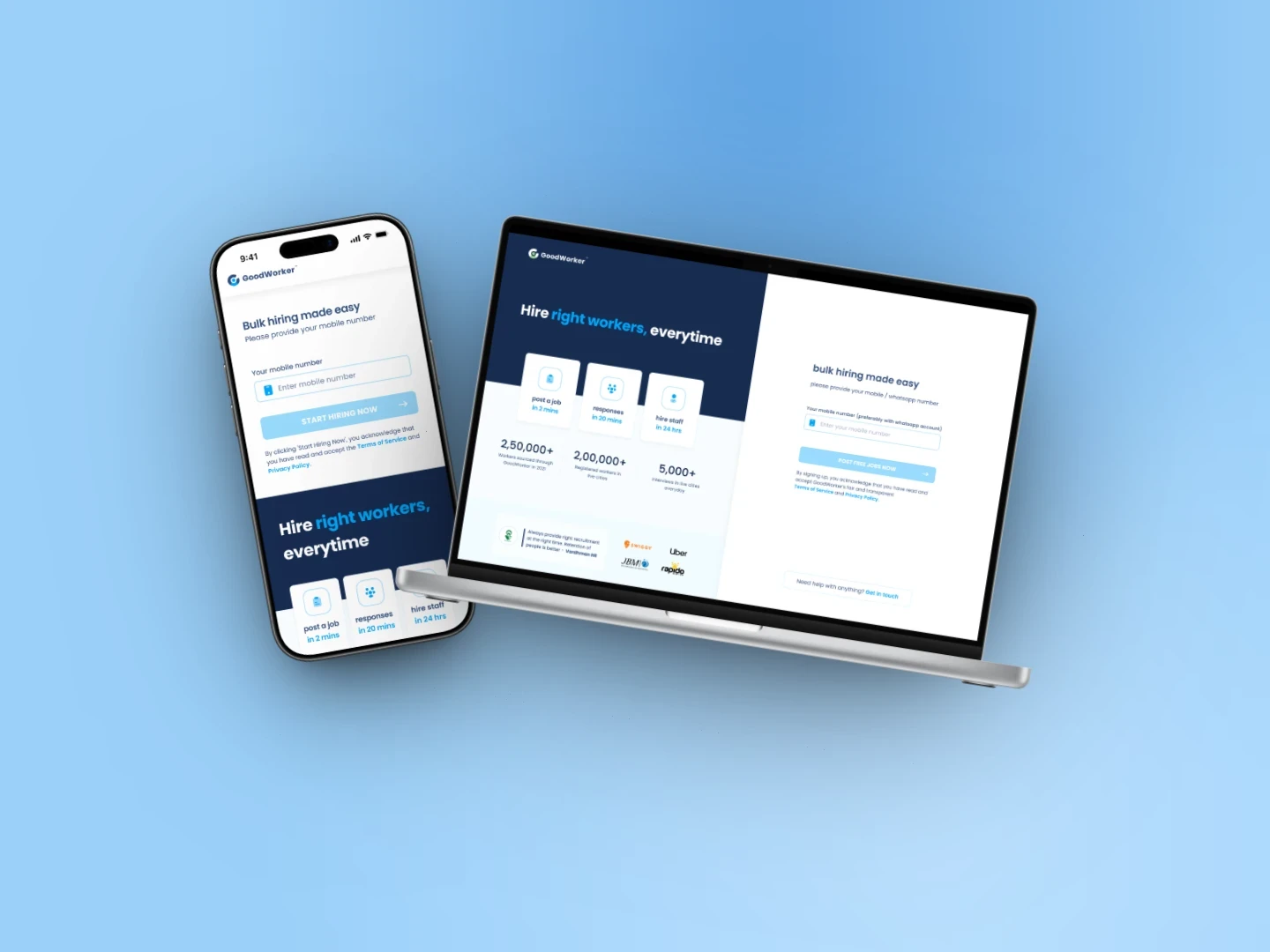
Sign-in by mobile OTP; account creation that routes cities outside the launch plan to the sales team; a three-step job post with a verification gate; job and candidate lists with stages, filters, sorting, edit and duplicate; profile, settings, FAQ and support; and the empty and error states. 30+ flows across desktop and mobile web, handed over ready for development and refined through sprint reviews.

Design Mockups
Sign-up · desktop and mobile web

Job post · candidate requirements

Mobile web · screening questions, company check, payment

Candidate pipeline · filters, stages and the candidate panel

Outcome
The portal shipped, carrying the research all the way into the product.
GoodWorker’s employer portal went live on web and mobile web. I don’t have post-launch numbers I can share, but every decision in this case study made it from an interview into the shipped product: separate paths for agencies and employers, the fee and authorisation questions on every post, verification before instant posting, and a candidate pipeline that replaced the spreadsheet.
Reflection
Don’t detach your instances.
This was my first design job and my first real design system. It felt slow at first, then like a superpower: 30+ flows only stay consistent, and only survive a redesign, when every screen is built from the same components.
Curious to know more?
This is just a small part of the design process — for the full story, get in touch